™
™Automation that runs itself. AI builds it. Code runs it. It heals itself.
Describe any workflow once. CodeCell compiles it into real code that runs without AI re-reasoning every step – fast, predictable, auditable. When something breaks, it repairs itself.
- From a plain-language description to a running cell
- ~60 s
- In a full production run, 18.4 s end to end
- 0 errors
- Per run, once a cell matures (from $0.026 on day one)
- $0.001
The problem
Two ways to automate. Both need a babysitter.
AI agents: unpredictable
They re-reason from scratch on every run, so you pay again for thinking already done. Same input, different answer – hard to audit, hard to trust.
Flowchart builders: rigid
Every box and arrow is hand-built, and rebuilt when the process changes. One API change breaks the flow, often silently.
Both end the same way
A human babysitting the automation – and the complex, judgment-heavy workflows never get automated at all. CodeCell is the third road.
The solution
One automation = one CodeCell.
A sealed, portable, self-healing unit – like a container, but it thinks and repairs itself.
The Agent
Compiles plain language into code and maintains it – all the intelligence, none of it in the runtime path.
The Code
A versioned, multi-file codespace of static code, with no limit on length or complexity. This is what runs.
The Sandbox
Isolated compute with its own storage for in-flight data – portable, auditable, runs anywhere.
How it works
Build once. Run deterministically. Heal on failure.
Build
Describe the automation in plain language. The agent compiles it into static code and contracts, then seals it into a versioned CodeCell.
Run
Deterministic code executes in its own sandbox – inference only where the task actually needs it, never re-reasoning the whole workflow.
Heal
On failure, the agent proposes a patch. It must pass the full regression corpus and a human approval before the new version ships – that failure never recurs.
Seeing is believing
Plain language in. A finished, error-free run out.
"Digest the last 24 hours of my Gmail inbox." One real production run, July 2026: one paginated fetch, 10 batched analyses, one digest written.
- End to end, trigger to finished digest (10 of 10 emails)
- 18.4 s
- No retries, no guesswork – the plan was already debugged
- 0 errors
- Per run on day one, falling toward $0.001 as the cell matures
- ~$0.03
Self-healing · a real case
Google changed the API. The cell failed loudly, got patched once, and never failed that way again.
- 01 · Fail
It failed at the contract boundary
The compiled code holds explicit contracts for what each connector returns, so the Gmail shape change was a hard failure – not a partial result that looks correct.
- 02 · Patch
The patch cleared the regression gate
The agent proposed a fix to the parsing layer. It had to pass every input and known-good output the cell had accumulated.
- 03 · Ship
Reviewed, shipped, locked in
A human reviewed the diff and shipped it. It has not recurred, and the corpus now covers that failure permanently.
APIs drift. Formats change. Edge cases appear. A cell never fakes success – and no one on your team gets paged.
Side by side
Easy. Efficient. Robust. Pick all three.
| Compared on | Flowchart builders | AI agents | CodeCell |
|---|---|---|---|
| Build a new automation | Flowchart builders:Days of boxes and arrows, built by hand | AI agents:A prompt – then cross your fingers | CodeCell:Describe it once – ~60 s to a running cell |
| Complex, judgment-heavy work | Flowchart builders:Too complex to express in boxes | AI agents:Handled, differently every time | CodeCell:Compiled into real code, judgment included |
| Cost and speed per run | Flowchart builders:Per-task fees that grow with volume | AI agents:Full inference on every run – slow and costly | CodeCell:Compiled code – $0.026 falling to $0.001 per run |
| Same input, same output | Flowchart builders:Yes, until something upstream changes | AI agents:No guarantee | CodeCell:Deterministic by construction |
| When an API changes | Flowchart builders:Breaks, and waits for a human | AI agents:Improvises, sometimes wrongly | CodeCell:Fails loudly, heals once, never recurs |
| Answering an auditor | Flowchart builders:Partial run logs | AI agents:Opaque reasoning | CodeCell:Every run logged, every version diffable |
Inside a CodeCell
From a sentence to a running, connected system.
Describe it once. Get real code back.
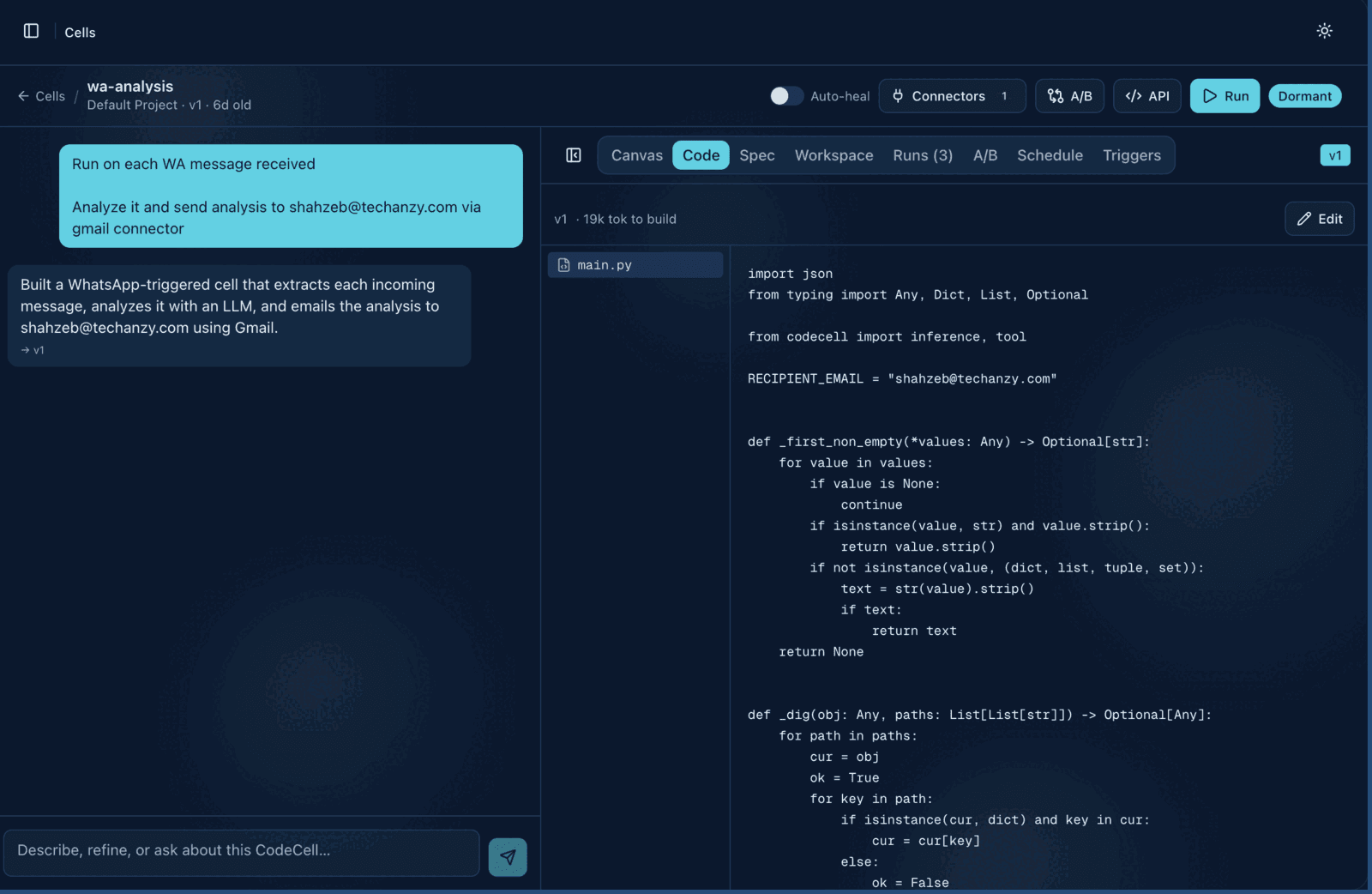
Plain language in
Describe the automation like you're briefing a teammate – no visual wiring, no drag-and-drop nodes.
Real code out
Every CodeCell compiles to readable, versioned code you can inspect, diff and own.
Wired into the tools you already run on.
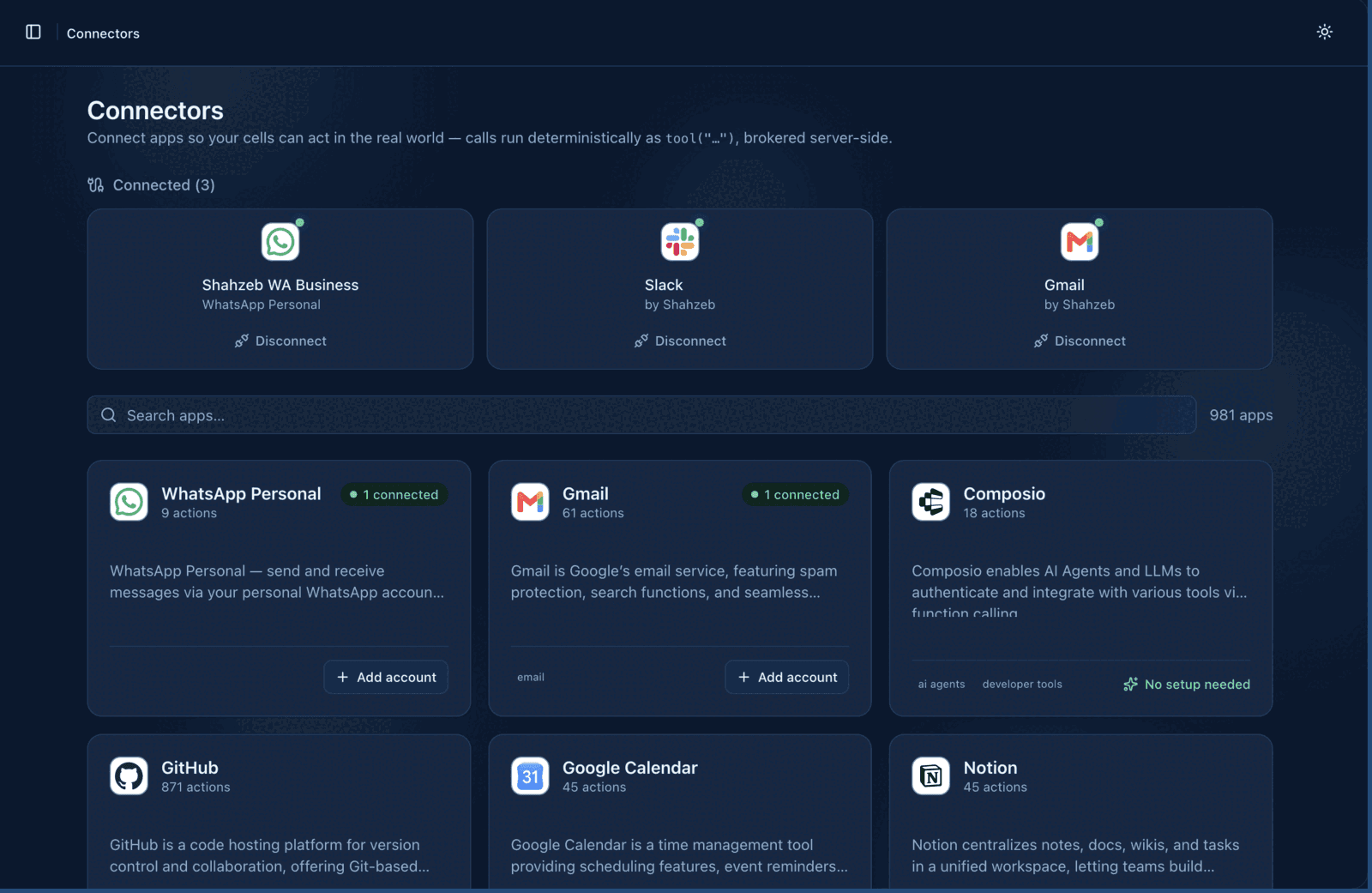
Bring your stack
WhatsApp, Slack, Gmail and hundreds more connect in a click – no custom integration work.
Brokered, not improvised
Every call runs deterministically as tool("...") on the server side, never re-reasoned mid-run.
Use cases
If your team can describe it, CodeCell can compile it.
These aren't modules or templates. Each is a description your team writes – the compiler does the rest.
Lead triage & scoring
CRM enrichment, pipeline hygiene and quote follow-ups.
Invoice processing
Transaction classification, reconciliation and expense audits.
Order tracking
Inventory alerts, vendor onboarding and SLA monitoring.
Ticket triage & routing
Escalation rules, sentiment digests and SLA breach alerts.
Candidate screening
Onboarding checklists, leave and policy workflows.
Log monitoring
Incident summaries, access reviews and deployment checks.
Daily digests
Cross-system sync, report generation and anomaly alerts.
Document classification
Audit trails, policy checks and filing reminders.
The platform
Everything an automation needs, built in.
Self-serve for your teams, an API for your engineers, managed cells for your critical workflows.
1,000+ connectors
One library of triggers and actions – CRM, ERP, email, storage, databases and your internal APIs. The compiler wires them in.
Compiler engine
Natural language in, working automation out. Every cell is test-run against real data before you rely on it.
Versioned by default
Every change is tracked. Diff, audit and roll back any cell at any time.
Smart resume
A failed workflow resumes from the failed step – never from zero.
Scheduling built in
Trigger any cell on any schedule. No external cron, no glue code.
API-first
Every cell is callable via API – embed CodeCell inside your own products and internal systems.
The economics
Your automation gets cheaper the more it runs.
Every edge case is healed once, so AI calls trend to zero and a matured cell runs at its cost floor.
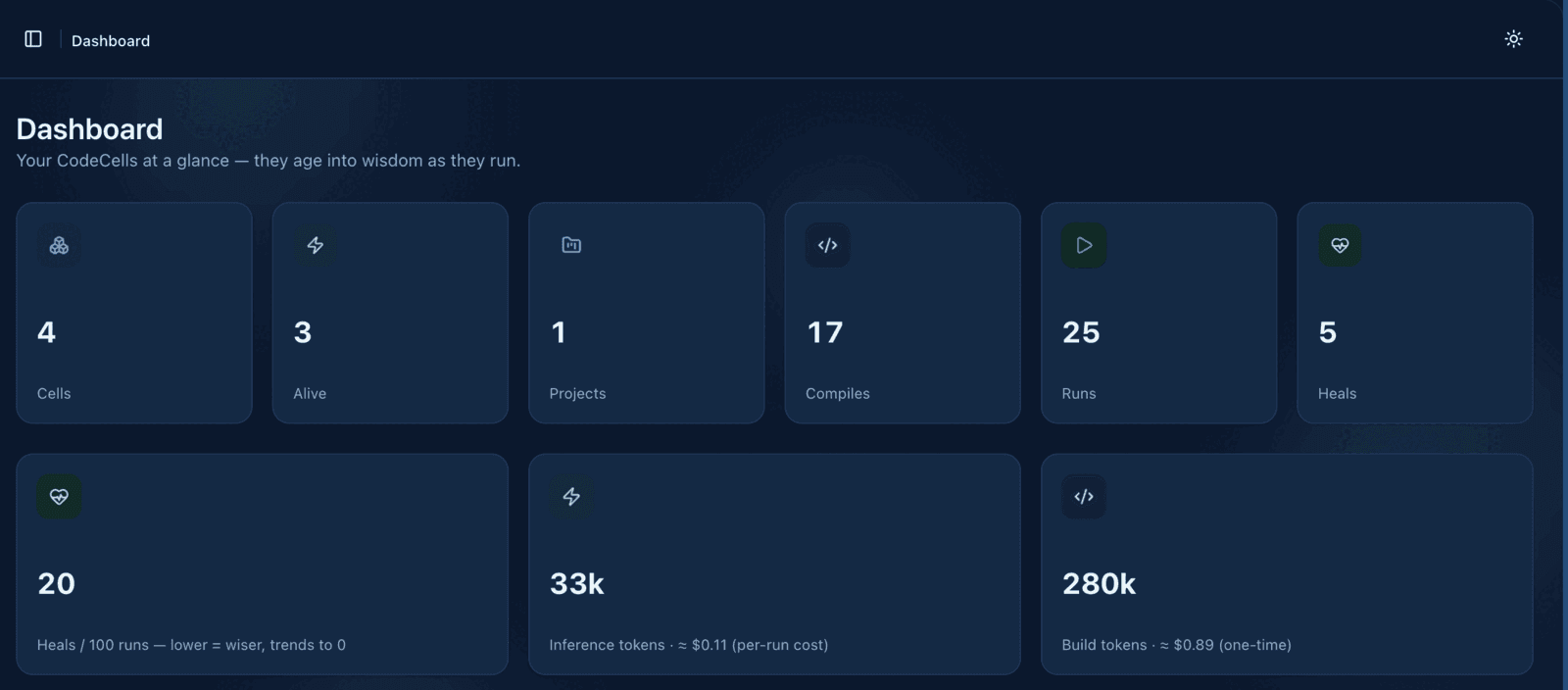
- Day one: compile + early healing
- $0.026
- Mature-cell floor, per run
- $0.001
Bounded
Every AI call is fixed in the compiled code – no runaway loops, cost quoted as a range before it runs.
Capped
Spend caps on every cell. No surprise overages, ever.
Security & governance
Built for teams that answer to an auditor.
Because the automation is code, governance isn't a feature we added – it's the structure itself.
Isolated by design
Every cell runs in its own sandbox with its own storage. A misbehaving cell cannot reach beyond its walls.
Auditable end to end
Every version diffable, every run logged input to output – show exactly what ran, when and why.
Human-gated change
No code changes itself silently. Every patch passes the regression corpus and human approval.
Data stays contained
Nothing is sent to AI that the code doesn't specify – and what is sent is visible in the code.
Pricing
Start free. Scale when you need to.
Free
Self-hosted runtime with community support – run the substrate yourself.
Usage-based
Managed runtime with the healing pipeline and team features built in.
Custom
On-premise infrastructure, SSO, audit logging and dedicated support.
See your workflow compiled, live. Bring one you wish ran itself.
A technical deep-dive with your engineering and ops leads. We'll compile one of your workflows in the meeting, then scope 1–3 pilot cells if it fits.
Book a call